Planoly’s Intentional Approach to AI
The Problem:
Building features quickly, that wouldn’t erase brand equity in our creator ICP.
Year
2023
Product
Fohr
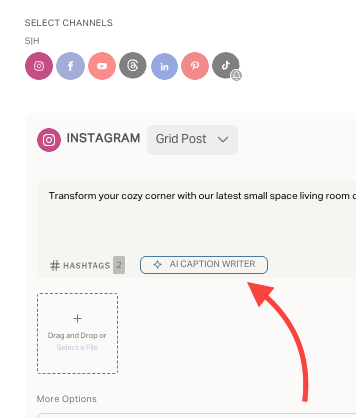
The Challenge
When AI started taking off, the expectation was to ship something quickly. But our creators weren’t excited—they were nervous. They’d spent years building their voice, and they didn’t want a tool that made everything sound the same.
So the real challenge wasn’t just speed—it was protecting what made their content feel like them. A basic AI feature might’ve been fast to launch, but it would’ve hurt NPS (and retention).
In discovery, this came up constantly: people didn’t want a generic caption generator. They wanted something that actually sounded like them. If it didn’t, they just wouldn’t use it. It needed to be trend sensitive, but it also needed to have low internal costs.
The Strategy
We used the initial launch as a learning surface:
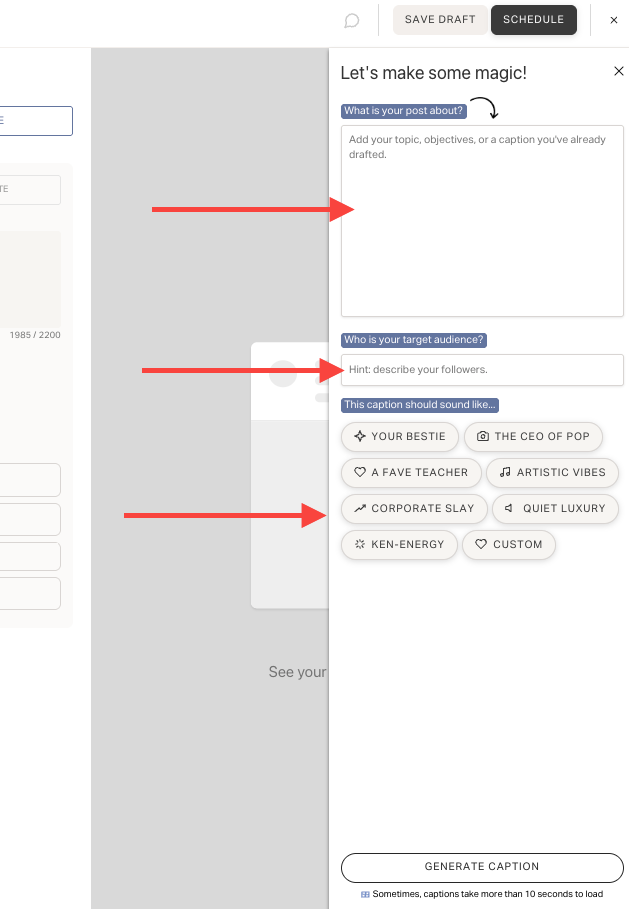
Prompt engineering first: We iterated on tone, structure, and inputs (audience, context, voice) to understand what got us closest to something usable.
Personas as a bridge: The predefined voices (a few of my 2023-coded favorites included “Your Bestie” and “Corporate Slay”) gave us a way to test how people think about tone, but also showed us the limits of a one-size-fits-all voice.
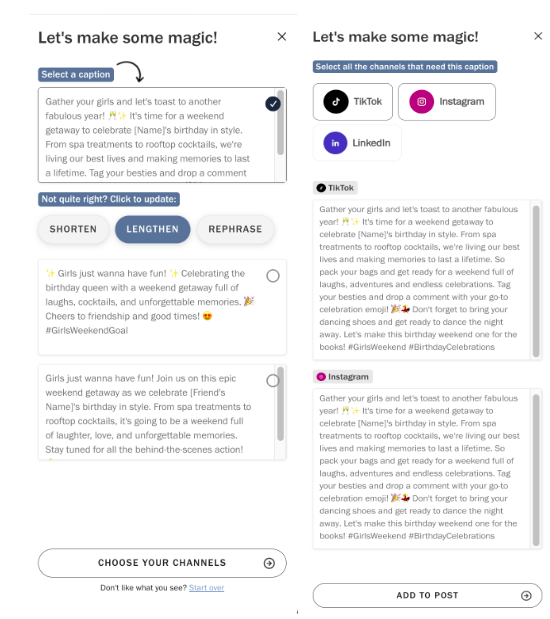
Move to a custom model: Once we had enough signal, we started shifting toward an Hugging Face model trained on user inputs—so instead of selecting a vibe, the system could actually learn how you write.
The Impact
The initial launch alone validated the direction:
53% adoption within the first month
xx% conversion rate from free users interacting with the feature to becoming paid users
Outperformed Black Friday (historically our biggest revenue driver) in terms of revenue, driven by increased usage and upgrades
More importantly, once we started improving voice accuracy, usage stuck. It shifted how we approached AI across the product and required user input.